
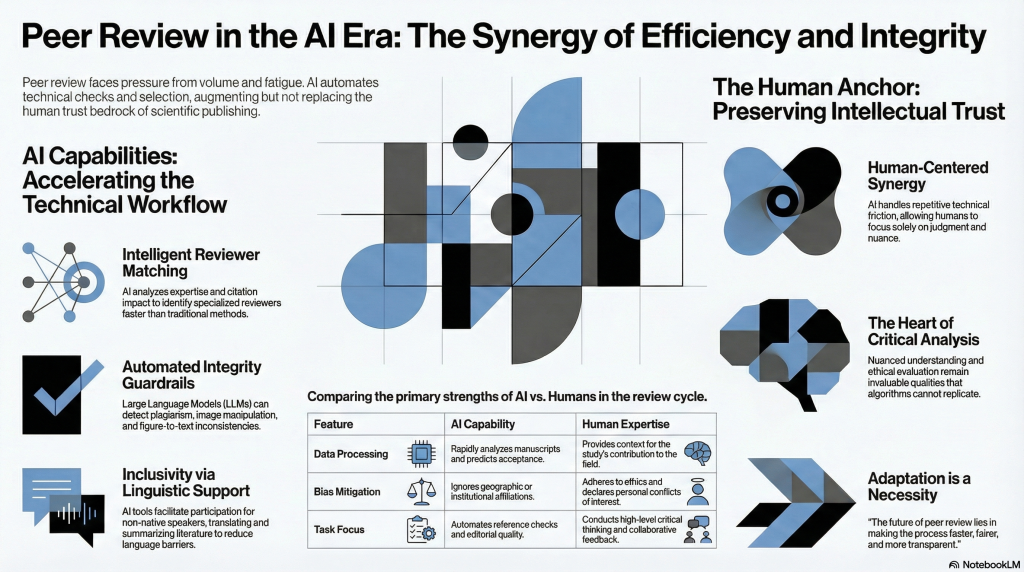
The scholarly publishing industry is navigating a “Black Box” crisis. As research output grows at an exponential rate, the traditional infrastructure of peer review—the undisputed backbone of scientific integrity—is under more pressure than ever. We are witnessing a systemic bottleneck where overwhelming submission volumes meet a thinning pool of exhausted experts.
In this high-stakes environment, adaptation isn’t just a theory; it’s a necessity for survival. We are at a technological and ethical crossroads. To move forward, we must look beyond simple automation and address the fundamental shifts in how quality, identity, and transparency are being redefined for the next era of science.
Here are the five essential takeaways regarding the future of peer review.
1. AI is the Triage, Not the Judge
AI is no longer a futuristic concept; it is already revolutionizing the “upstream” stages of the workflow. Tools like synaps.io and Scorus AI are optimizing reviewer selection and providing rapid research summaries within a critical 24-48 hour window.
This isn’t just about speed; it’s about protecting a journal’s reputation. AI-driven screening is now vital for identifying high-stake threats like Paper Mills and ensuring the integrity of Clinical Trials. By flagging image manipulation and scope mismatches before a human editor even opens a file, we remove the friction of repetitive tasks. This allows the human expert to focus on what algorithms cannot replicate: nuanced understanding and deep critical analysis.
“The future of peer review is not just technological; it is human-centered.” — Ashutosh Ghildiyal
2. The Hidden Cost: The Counter-Intuitive Ecological Price of AI
While AI promises efficiency, we must confront a sobering reality often absent from the hype: the environmental impact of Large Language Models. Current data indicates that generating a simple 100-word email via ChatGPT can consume the equivalent of a bottle of water.
As thought leaders, we must frame this as a moral choice. Is a marginal gain in manuscript processing speed worth the depletion of our planet’s limited resources? The future of peer review requires us to weigh our technological hunger against the ecological footprint we leave behind.
3. Identity is the Engine of Trust, Not Just a Variable
For decades, we relied on “blind” review to mitigate bias, but identity is not a variable to be hidden—it is an engine for trust. Without representation, peer review remains an “exclusive club” that risks becoming an echo chamber of similar ideas.
The industry’s blind spots are often literal. Jessica Miles of Cell Press shared an anecdote where a journal cover featured a “Western-facing” globe by default. Recognizing the bias, the solution was intentional: creating two sets of covers—one Western-facing and one Eastern-facing—allowing editors to choose a perspective that resonated with their community. Identity matters because trust is impossible to build if a researcher doesn’t feel “seen or heard” in the process.
“If for an instance we change the authorship of a manuscript submitted by a well-reputed institute by some third-world country’s authorship, the perception, reaction, and priority of the editor changes… there is a need for developing databases where even the editor does not know the identity of an author to avoid elite spirals.” — Maryam Sayab
4. The Rise of “Journal Agnostic” Review via Preprints
The meteoric rise of preprints is “decoupling” the peer review process from the final publication. By moving away from Impact Factors as the ultimate determinant of value, we give power back to the science itself. This shifts review from a one-time gatekeeping event into a dynamic, work-in-progress conversation.
To navigate this landscape, authors are increasingly being offered three distinct paths:
- Preprint publication alone for rapid dissemination.
- Preprint publication combined with regular peer review.
- Traditional, closed regular peer review.
5. Peer Review as “Good Karma” and a Transferable Skill
We are moving away from seeing peer review as a “thankless, voluntary service” and toward a professionalized model. However, this shift brings a strategic tension. While “Professional Peer Reviewers” offer speed, they often rely on rigid checklists that can limit editorial independence and miss the “nuanced perspective of a published author” in the same field.
For the next generation, peer review must be viewed as a vital transferable skill. It teaches how to provide constructive, professional critique—a capability invaluable in both the academy and the private sector. It is an act of professional development that strengthens the global scientific village.
“Peer review is a good karma… it is also altruism. We are expressing that… I’m doing good things to somebody and somewhere in the future somebody else will be doing the same favor for me.” — Haseeb Irfanullah
Conclusion: The Road to 2025 and Beyond
The evolution of peer review is no longer optional. As we integrate algorithms to safeguard integrity and manage the massive flow of global data, we must remember that the heart of science remains a human judgment.
Transparency is the final frontier. As Tony Rosselauer notes, if we are making judgments that can make or break careers, we should be prepared to stand by them in public.
As we automate the checks, are we prepared to take more personal accountability for the judgment? Will you sign your next review?