
In recent years, scientific publishers have increasingly been cast as the villains of the research world; accused of exploiting scientists, monopolizing knowledge, and reaping massive profits from publicly funded research. However, the origins of scientific publishing were rooted in the noble ambition of spreading scientific knowledge more efficiently across the globe, to modernize and democratize science.
The long journey of scientific journals
Before 1665, scientific findings spread through personal letters, books, and monographs. This method suffered from significant limitations: correspondence networks were exclusive, and the slow pace of book publishing hindered timely dissemination. On January 5th, 1665 the first ever scientific journal was published in France, with the name “Journal des Sçavans” (1). Three months later, the Royal Society of London started to publish “Philosophical Transactions”, the first ever journal that include some sort of peer review. It consisted in that all the partners of the society would agree to publish a specific paper, a process more similar to censorship than to peer review, of which we want to talk more in a future post (2). What started as a side project became a transformative innovation, establishing journals as the cornerstone of scientific communication for centuries.
In those early days, journals were published by scientific societies and circulated in print among their members. This model flourished throughout the 19th century and endured until the mid-20th century. After World War II, however, a major shift occurred. In the spirit of democratizing science, many scientific societies outsourced the technical and logistical aspects of publishing, especially printing, distribution, archiving to commercial publishers, which were too tedious to manage internally (3). While this alleviated operational burdens, it also allowed private companies to gradually seize control of the most influential journals and doing so, of the most important publications in science. All scientists dream to publish in a big journal, and these companies already knew that controlling big journals would mean to control academic publication and its market.
The modern era of for-profit publishers
By the 1960s and ’70s, the consequences of this shift began to surface. Journal subscription prices soared, far outpacing inflation, sparking what became known as the “serials crisis” in the 1980s (4). As library budgets remained flat, institutions found it increasingly difficult to afford journal subscriptions, cutting off access to scientific knowledge, especially for smaller or less affluent universities. However, no one put an end to the serial crisis therefore it is still ongoing and growing year by year. Notably, even Harvard publicly declared in 2012 that it could no longer afford these escalating costs (5).
The serial crisis was exacerbated by publishing giants like Elsevier, who in 1998 introduced the “Big Deal” model, bundling hundreds of journals into a single, expensive subscription package (6). Though initially marketed as cost saving, this tactic effectively locked universities into expensive contracts. By that time, Elsevier alone controlled about 20% of all published journals. Furthermore, other big journals publishers (Springer, Taylor & Francis, etc.) followed Elsevier’s example, gaining monopoly over the market and often forcing the research institutions to choose between journal providers, limiting de facto the access to science.
Technology to the rescue of science?
The arrival of the internet offered a potential lifeline. Digital distribution drastically reduced dissemination costs of paper journals, offering PDF as the new standard, and paved the way for new models, such as Open Access (OA). Pioneering platforms like arXiv (1998), PLOS (2003), and MDPI (2007) reimagined publishing through the lens of free and immediate access to research. Nevertheless, OA came with its own price tag: the Article Processing Charge (APC), shifting the cost burden from readers to authors. Unsurprisingly, legacy publishers adapted swiftly, adopting hybrid models that allowed them to profit from both subscription (pay-per-view) and OA routes (pay-to-publish), while still dominating the market, owning over 50% of major journals.
Among all the initiative that surged with the advent of internet, it is worth mentioning SCI-HUB, a platform (mostly illegal) that allow gathering scientific publications free-of-cost no matter the publisher (7). It has been a big shift in science: in emerging countries, where universities could not afford the expensive publishers’ subscriptions, it has been the life jacket of many scientists desperate to find and read scientific papers. Formally prohibited and banned in western countries, it has been used widely by western scientists to read specific papers from publishers with whom their institution did not have an agreement. This example shows that science and scientists need open science no matter what they personally think about it.
The current issue
Despite all these initiative, for-profit academic publishers still dominate the market: free (or low-cost) publishers moved slowly and public institutions failed to establish credible alternatives. Furthermore, some of the early initiatives born out of the internet innovation wave become part of the problem. Platforms like PLOS, Frontier or MDPI, created to offer a different solutions to scientist, once gained tractions they switched their model to deeply for-profit, offering APC at very high prices, with “unclear” policy about editorial transparency and “uncertain” peer-reviews practices.
In spite of the digital shift and the public funding behind most research, major scientific publishers continue to generate staggering profits with little transparency or return to the academic community. Elsevier, for instance, reported operating profits exceeding $1 billion dollar in the last five years, with continued growth at a rate around 7% and average profit margins routinely above 30%—a figure rivaling that of tech giants like Apple. Springer Nature, another publishing titan, posted revenues of over €1.7 billion in 2022, 2023, and 2024 and profit margins above 35%. These astonishing profits have been going on for quite a long time, as reported from the two graphs below, from 2007 and 2023 data. Major publishers mostly gain money from institutional subscriptions and author fees, despite the publishers not paying for research, peer review, or editorial labor—all of which are contributed voluntarily by academics. The fact that taxpayers fund the research, scientists donate their labor, and yet universities must pay steep fees to access (or publish) the results, exposes a deeply flawed and extractive system (9).
The complementary business on scientific content
A complementary but (still) very lucrative business for these companies is the creation of scientific databases that they sell to universities and research institutions. Let me explain how it works: we know that scientific articles are published by scientists for-free (in pay-per-view) or paying a fee (pay-to-publish). In both cases, authors retain authorship rights, but publishers retains exploitations rights. It means that they are free to use the findings of the papers for lucrative business. Since the beginning of the internet era, publishers started to extrapolate data from the papers to build databases, like Reaxys (reaxys.com), SciFinder (scifinder-n.cas.org), Pharmapendium (pharmapendium.com), Embase (and many others), that are sold back to the research institutions for (big) fees. These databases contain arranged information coming from millions of articles (on which they already gained money), that are very useful for scientists. So institutions generate the content of the articles, pay to publish it or to visualize the publications itself, but they also pay to visualize this same content sorted in private databases.
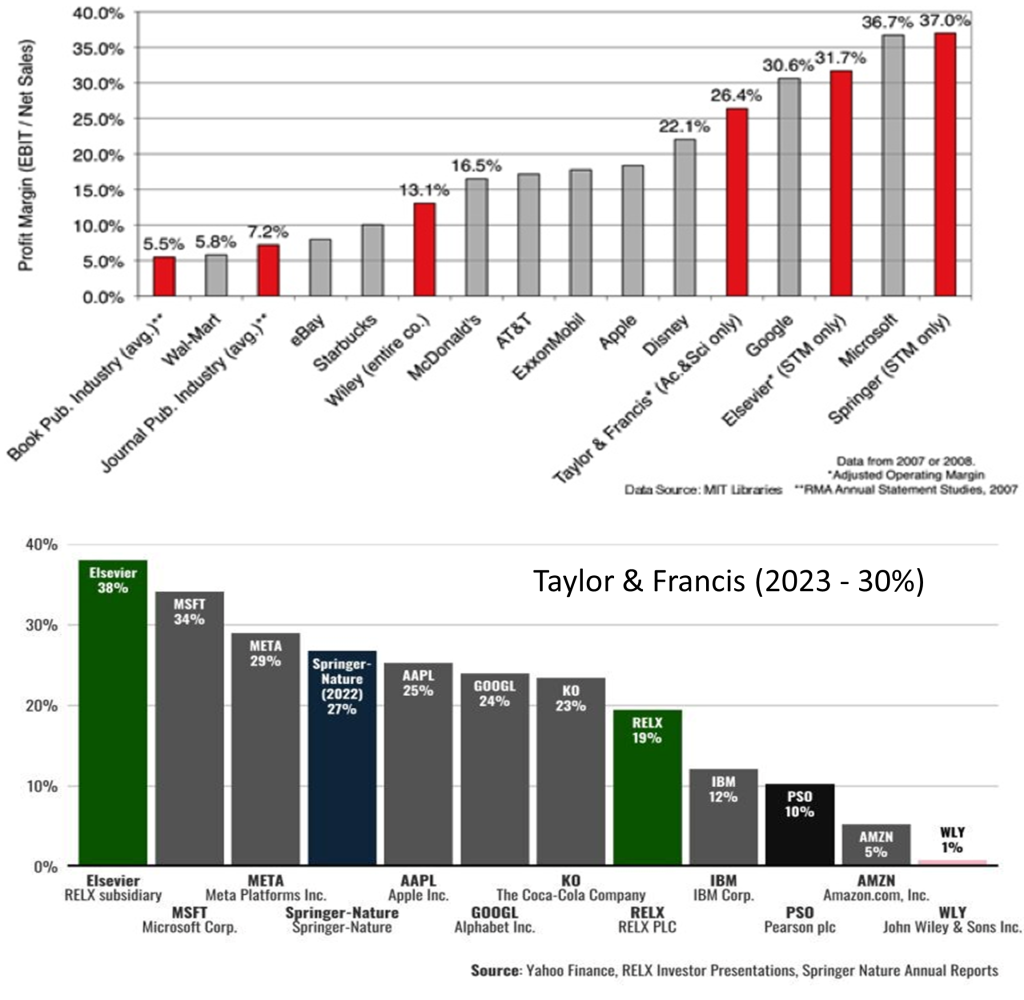
Figure 1: profit margin of few major companies (in grey) compared to major publishers (colored) in 2007 (above and 2023 (below). The profit margin of Taylor & Francis is reported as text in 2023. Sources are reported in the figure (9, 10).
Conflicts of interest and possible solutions
Let’s be honest: this system persists because it benefits powerful stakeholders. Large publishers report staggering profit margins. At the same time, journal gatekeeping empowers senior researchers and institutions to maintain influence and control within their fields. Prestige is tied to publication, and publication is often tied to the same elite circles. Breaking into these networks can be make-or-break for emerging scientists.
Understanding this history is essential to shaping the future of science communication. Today, we stand at a crossroads, with three major developments shaping the landscape:
- Expansion of Science: The global scientific community is growing. More papers, more journals, and more countries are contributing to research at an improving quality standard. In addition, more platforms and newer indicators are popping out and gaining ground within science.
- Policy Changes: Governments and institutions are taking action. The European Union advocates for free and open publication models. In the U.S., both government and academic institutions express growing resistance to profit-driven publishing. Countries like India are pushing for national licensing deals to ensure equitable access and reduce costs. China is now the world-publishing leader and is trying to push the creation of English-Chinese journals for its own publications, journals that will be government owned or controlled through national companies.
- Innovative Models: New tools and platforms emerge regularly (like http://reviewpro.io), ranging from AI-assisted article generation to repositories for data, negative results, and reproducibility-focused studies. Traditional journals are no longer the only gatekeepers of scientific value.
Despite these promising shifts, a crucial ingredient is missing — public pressure. The majority of society remains unaware that access to knowledge, a cornerstone of progress, is locked behind costly paywalls or APCs. Science has yet to become a popular cause for civic activism.
Yet this may be the most opportune moment in history to challenge the dominance of commercial publishers. The political will exists. The technological solutions are ready. The alternatives are multiplying. What is needed now is awareness, advocacy, and a collective push for change.
Luca Narduzzi
Do you want to know more about the scientific publishing industry?
Follow our podcast at https://open.spotify.com/episode/0WW6ZR7vSdvfCZp2y4Nf0A?si=fO-PkeWoTvOJCTaxKzoUtQ, or follow prof. Khalid Khan youtube channel https://www.youtube.com/watch?v=4oVy1bPADJo
References
- Journal des sçavans: The First Scientific Journal Begins Publication https://www.historyofinformation.com/detail.php?id=2281
- In praise of Peer-review https://www.nature.com/articles/s41563-023-01661-7
- How Academic Science Gave Its Soul to the Publishing Industry https://issues.org/how-academic-science-gave-its-soul-to-the-publishing-industry/
- Serial Crisis https://en.wikipedia.org/wiki/Serials_crisis
- Harvard University says it can’t afford journal publishers’ prices https://www.theguardian.com/science/2012/apr/24/harvard-university-journal-publishers-prices#:~:text=A%20memo%20from%20Harvard%20Library,library%20around%20%243.5m%20a%20year
- The evolution and revision of big deals: a review from the perspective of libraries https://revista.profesionaldelainformacion.com/index.php/EPI/article/view/86465
- Sci-Hub https://en.wikipedia.org/wiki/Sci-Hub
- Money, Time, Trust, Control – How commercial publishers drain science https://blogs.lse.ac.uk/impactofsocialsciences/2025/11/19/money-time-trust-control-how-commercial-publishers-drain-science/
- The Money in Scientific Publishing https://danielroelfs.com/posts/the-money-in-scientific-publishing/
- Academic economic parasitism https://anticap.wordpress.com/2011/09/02/academic-economic-parasitism/